Sunday, September 16, 2012

Salt Lake City? Utah? Really?

It's like this. We have been dry camping off and on for a few months and it was time for some luxury. We are sort of heading to the Grand Canyon and this strange place kept appearing on the maps. Turns out there was a full service RV park just outside of Salt Lake City. Liz tells you about that part of the trip and I finish up on our last few days in the Yellowstone area.

Our next to last full day in Yellowstone we investigated Lone Star Geyser. This is one off the beaten path requiring a two or so mile hike to get to it. Got very lucky. Just as we made the last turn, the darn thing started erupting. We ran the last fifty yards or so. Wasn't all that spectacular but was a sure enough geyser. Most of the people who'd been waiting left but one couple stuck around. He had been reading the logbook kept on a convenient stand nearby and noted that lately this geyser would often erupt again 20 or so minutes after the first. That's just what happened, a much better eruption than the first! Pure dumb luck.


Our last day we bicycled down a trail to the only natural bridge in Yellowstone. The bike ride was nice but we were just a little underwhelmed by the natural bridge itself, especially as you couldn't even get close to it, much less walk across it.


Leaving Yellowstone was hard. Heck of a nice place with something new every day. A person can get used to buffalo jams and being bear aware.

Liz Here
Temperatures were falling in Grand Tetons too. After hiking the Taggert Trail and freezing a couple of nights it was time to seek warmer pastures. We drove from the Grand Tetons thru swank Jackson Jackson Hole names the valley famous for skiiing while Jackson is the actual town. Sticker shock hit here where diesel fuel cost $4.65.


View from Taggert Lake in The Grand Tetons


Lake Taggert in early September

 
Elk Antler Archways surround the Square in Jackson, Wy.


We left Grand Teton on September 5 and headed for Salt Lake City to re-supply and sightsee. Our drive from Jackson Hole to Evanston, Wyoming took us into Idaho, back to Wyoming, then into Utah and then back to Wyoming, a clear illustration of how mountains and rivers do not follow state boundaries. One of Utah’s claims to fame is that only Alaska and Nevada are less explored than Utah. Parts of Utah have never been stepped on.


We went from waking up in a regrigerator to waking up in a freezer. So we wanted amenities like a pool, electricity and cable TV for weekend football. We also did not want to drive through Utah and miss the Great Salt Lake. We booked the Pony Express RV Park due to its proximity to the Great Salt Lake. The location was reminiscent of Butte because of a big Chevron refinery across the way. The campsites for large RVs were mostly full with lots of Texas plates so apparently this site caters to Chevron workers. A fact that Mike has noted with dismay many times is that in 1980 the US was the largest exporter of finished goods and the largest importer of raw materials. Today the US is the largest importer of finished goods and the largest exporter of raw materials. Throughout the Western states we’ve visited so far (Montana, Wyoming, and Utah) the extraction industries dominate. 


Salt Lake City and County Building
Note the great stone carving.
 

We happened to visit downtown Salt Lake City (SLC) on a Sunday when a Mormon conference occurred so even though Sunday services are not normally held in Temple Square, they were in place this Sunday, Sept. 9, 2012. Mormons limit their church size to no more than 400 congregants so when the church hierarchy needs to speak they call a conference to tell everyone at the same time what is up. We passed by Mormons walking to the Temple in their Sunday best. Women wore hemlines with varying lengths just like anywhere else in the US. Families seemed larger than typical as borne out by the fact that Utah has the nation’s highest birth rate. The Mormons we saw were not polygamists. We haven’t seen TV‘s “Big Love” but we saw one-man and one-woman unions on the sidewalk. With so many young families Utah consumes more Jell-O than any other state. (Bill Cosby, Jell-O’s spoke person presented the state house with a plaque of honor from Jell-O.) With the largest number of teenagers per capita, Utah has more radio stations than any other state. Mike noticed one Ferrari and a limited edition Acura as tributes to the affluence ound here.

Seen in parking lot of museum. 650 Yamahas are a favorite of mine and you seldom see one chopped.

 
Zero scape Plants optimize the dessert


We parked for free and walked around downtown SLC and then drove up to their brand new Natural History Museum which opened less than a year ago. It blended modestly into the mountains in the back of the city next to wonderful trails and a botanical garden. As the Mormons are of English descent and as such are the first and largest population to settle Utah, like their ancestors they prefer green lawns and are reluctant to transition from lawns to “zero scapes”.  However the museum‘s landscape is a living example of natural and attractive plantings for a parched place. Mike admired the ginkgo trees in particular as a uniquely ancient species. The story of evolution is alive and well in the geological exhibits found in this fine museum.  


View from the Salt Lake City Natural History Museum.
Solar panels power the Natural History Museum.

 
All these fossils were found within 50 miles of Salt Lake.


Utah’s total population is 3 million with 80% of that population live along an 80 mile corridor. Lining the corridor are mountains. What were once depleted silver mines are now ski resorts world famous for “The Greatest Snow on Earth“.  Park City, Sundance, Alta and Snowbird are famous resorts. Movie folk make SLC their escape from Hollywood. Skiing and the most national parks in any state make tourism the third largest industry in Utah. Utah‘s #1 employer is Hill Air Force Base with 40,000. 2nd industry for employment is mining/extraction.


Unique Geology of Utah Contrasted to US

These also were found near Salt Lake City.
                                    The Great Salt Lake and Why it is No Alcatraz

We visited a state park on Antelope Island, the largest island out of 10 in The Great Salt Lake. We visited a ranch on the island and enjoyed seeing what else, antelope and again lots of buffalo. Lots of birds migrate thanks to brine shrimp flies. The flies eat the brine shrimp eggs and the brine shrimp (also known as sea monkeys) eat the algae living in the lake and that's as complex as this ecosystem gets - no fish. Morton Salt mines their salt near the Great Salt Lake. Trillions of tons of salt make the water’s salinity unbelievably dense.  The historic ranch on the island is where Mormons dating back and including Brigham Young kept their cattle.


Antelope on Antelope Island, of course.


Blacksmith Shop
Interior horse-drawn Cowboy Camper
 

One story that tells a lot about the salinity of the Great Salt Lake is how a man, Jean Baptiste was sentenced to live on an island in the Great Salt Lake because he was convicted of grave robbing. When a man saw Jean Baptiste wearing his recently buried brother’s burial suit, the locals searched his house and found loads of clothing and jewelry stolen from the coffins of their dead. The judge sentenced him to live on Fremont Island in The Great Salt Lake since his crimes were so egregious as to make him unfit to live among normal convicts. After his 1st month on the island the sheriff stopped there to deliver food. Jean Baptiste was no where to be found. After a lengthy search they gave up concluding that Jean Baptiste floated to shore on the buoyant Great Salt Lake. He was never heard of again. 

 
Mike with Great Salt Lake in the background.

Marina at The Great Salt Lake

We bought a professionally guided bus tour of the Kennecott Bingham Canyon Copper Mine, the largest open pit mine in the world. The mine begun in 1906 is visible from outer space. It is three-quarters of a mile deep and 2 and half miles wide. 2400 workers run the mine 24/7. It has produced more than 16 million tons of copper and mountains of tailings (waste) since only one percent of what they extract is usable. 


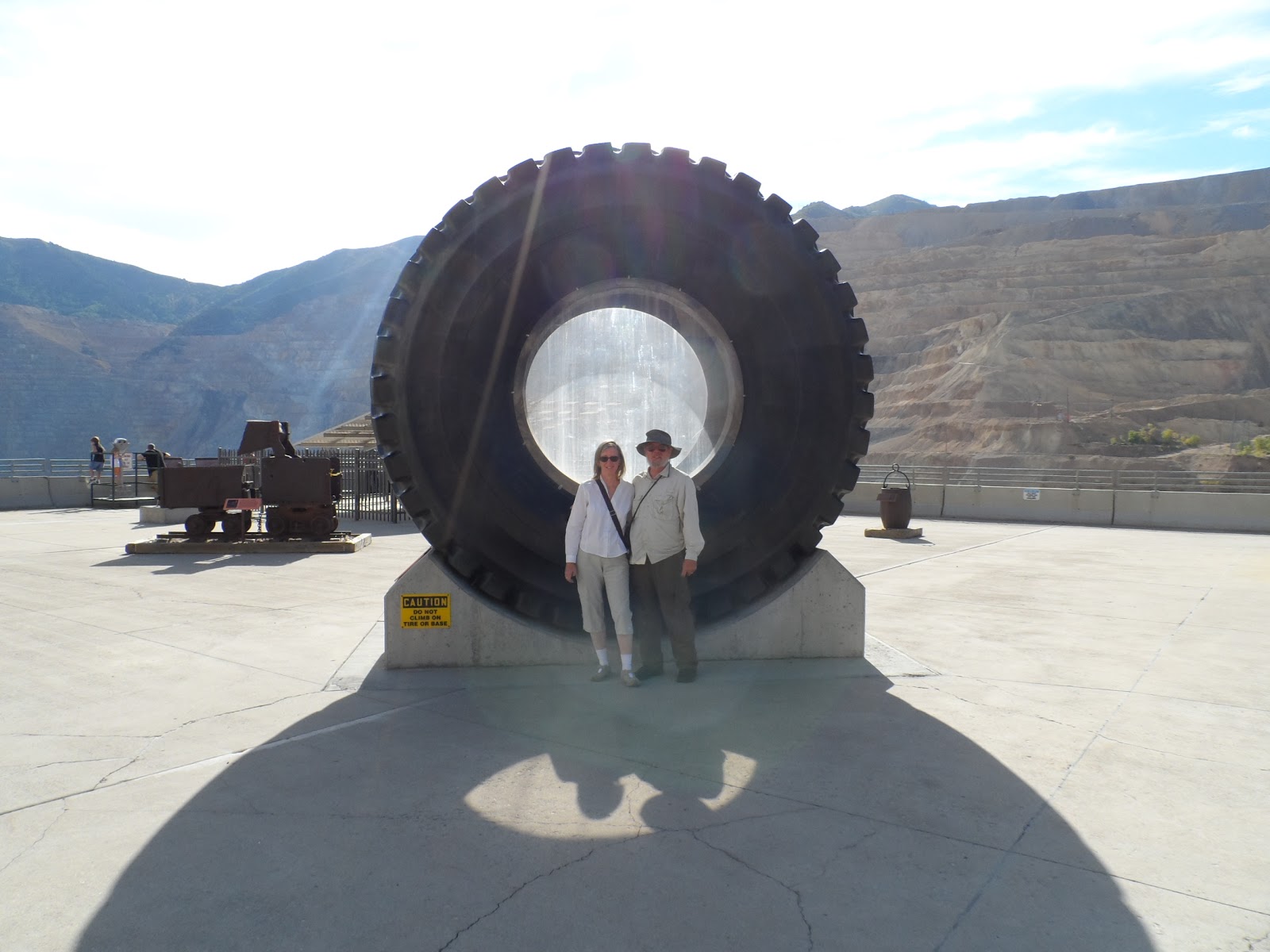
The mine‘s “Lectrahaul” truck can haul 170 tons. 23’ wide X 19’ high X 38’ long this truck operates in the Bingham Canyon Mine. Tires wear out in 3 months. Mike describes driving the Lectrahaul is like driving a 2-story house from a second story window.

 
Liz, Mike and Lectrahaul Tire at Bingham Canyon Mine

Remember Sinclair Gas Stations with Dino, the dinosaur as their mascot? Sinclair was sold off to Arco Oil and then BP in the Eastern US but in the western US 2067 Sinclair Stations blanket the region. Sinclair Stations are throughout Yellowstone. The owner is billionaire ($3.1B to be exact) and SLC native Robert Earl Holding. This fact was pointed out by our guide as he dropped off a couple in our group at the Grand America Hotel, the nicest hotel in SLC. Every room is a 900 square foot suite and probably relatively cheap to book due to low demand.   

 After 5 days that included one 9-hole round of golf (our first game since Mackinaw) at a municipal course we left SLC with a deepened appreciation for its urban order. Light rail, ample walking/bike paths (where people yield to horses) and radio advertising for Utah 2020, a plan for higher education with an express goal to educate and certify citizens in specialized tasks (instead of importing those workers from India like much of the rest of the US is doing) are admirable.  


Next we drove towards the national parks in southeastern Utah. We stopped midway in Price for lunch and visited the College of Eastern Utah’s Prehistoric Museum. A paleontologist’s wonderland unfolded. The discovery of new species of dinosaurs is a constant. The museum’s director of education (a wannabe retiree himself) made conversation with us. He even told us of a Bureau of Land Management (BLM) roadside site where we spent a night for free. Then he stopped by to visit us on his way home from work and told us where to see big horned sheep.


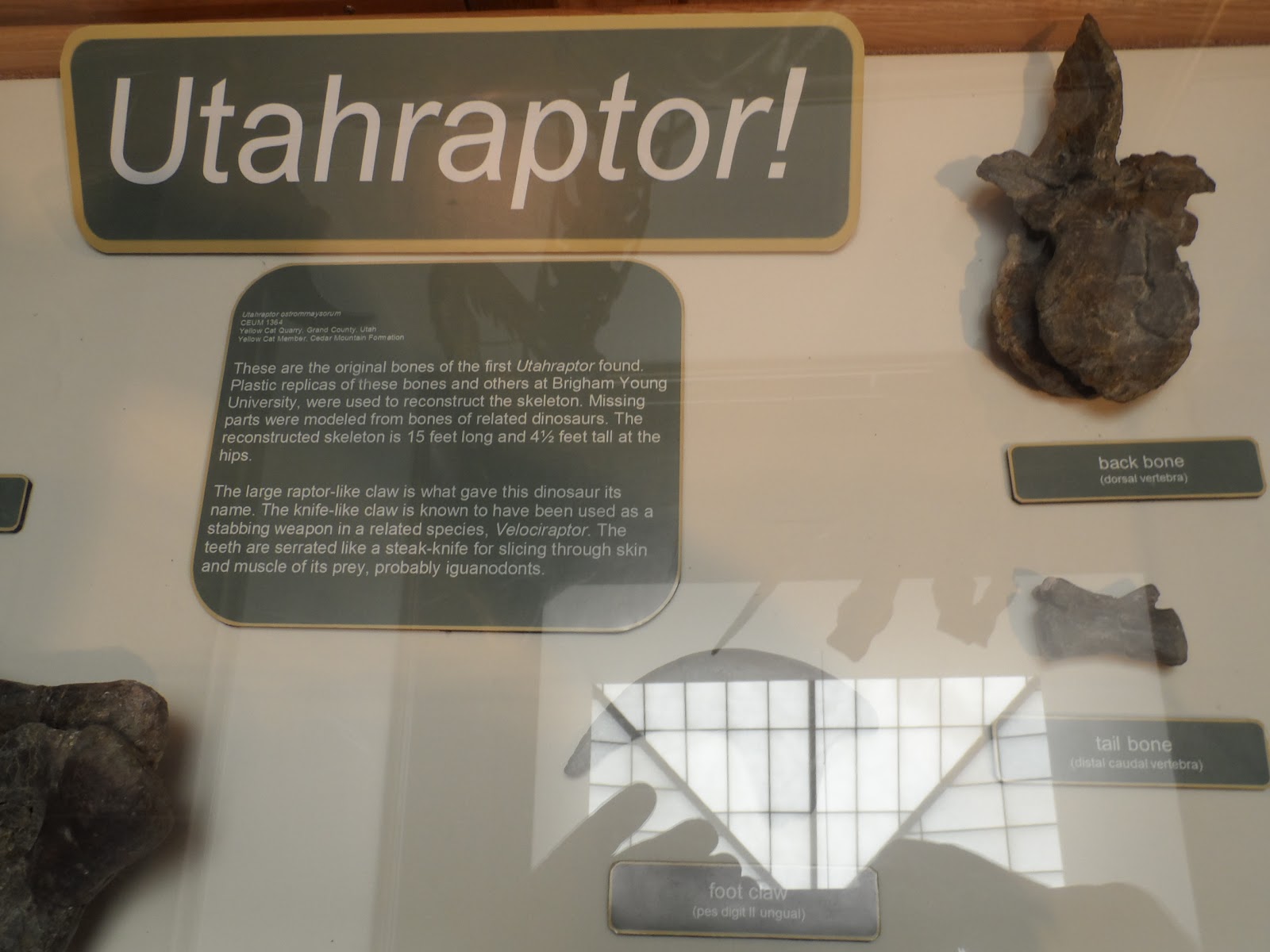
Utahraptor named by Paleontolgists at College of Eastern Utah in Price, Utah

CEU reassembling Dinosaur Fossills


Free Camping Site on BLM land


Finally, we see a bighorn sheep in the yard of an abandoned house.
 

German Mom, cranky child and Utahan Dad from Munich on vacation in Dead Horse Canyon
We booked 7 nights in a commercial park in the town of Moab since national and even state parks appear booked or else first-come-first-serve walk-in sites without power. This time of year Utah is a destination for Europeans with September vacations and the “newlywed and nearly dead, no offense” as one ranger told us. Obviously this trip seems so exciting and exclusive after so many years of being attached to our jobs and our children in school.  
"Just Married"
How did he get away with bringing a fishing boat on the honeymoon?


View from Dead Horse Point
Phosphate Evaporation Ponds near Colorado River

 
A state park called “Dead Horse Point” stood out so we called and lucked into an RV site with electric (no water) for one night only, $20. It was a back-in site so it took us a while to back-in. This is the time when we wish we’d worked as trucker drivers or school bus drivers. But we cannot always expect a pull-thru camp site so we keeps practicing, Mike as driver, me as “’mon back”. We actually have one dent in the trailer that I caused by putting a folding camp chair in front of where the “slide-out” (room expander) was sliding out. We were amazed that the flimsy chair held up and did not move or crumple but the 5th wheel’s slide-out got a kiss-like dent (after Mike popped out an even bigger dent). Oh, well, that‘s the price of a life in motion.


Dead Horse Point is a place with stunning views of the Colorado river valley, just half as deep as the Grand Canyon and half as far across but with bends in the river where cowboys would round up horses and pick the best ones. They’d bring them through a “neck” where the bends in the river brought the high ground to a point and block the exit with juniper branches. One year they forgot to open the neck and the unwanted horses died of thirst just 2000 feet above the Colorado River.

A very typical view.
I keep thinking of Road Runner cartoons.
There are lots of movies that use this area, including Stagecoach, Butch and Sundance, Thelma and Louise.


Somewhere down there is the Colorado River.
Liz in Dead Horse
 

Saturday, September 1, 2012

Yellowstone again

Well of course we came back to Yellowstone. We only left because we couldn't find a reasonably priced campsite. They were ALL full! Not as though the time spent at Glacier and Lewis and Clark Cavern were wasted. So now we're on the south side of the park at Grant Village, a primitive-only site. I don't know if I've explained primitive camping (boondocking) adequately so here we go.

Many state and national parks offer a low cost service, mainly just a parking space and rest rooms, showers and dump stations nearby. In the case of national parks that's about 20 dollars a day, half that if you hold a Senior Pass, available for a mere ten bucks when you reach 62. Hell of a bargain! So we're doing a lot of squatting on federal land cheaply. Of course, we need to run the generator for AC and to charge the battery and uproot the trailer every few days to replenish water and dump waste greywater and other holding tanks but it's still a great way to camp cheap. In Yellowstone it's the only way with the exception of Fishing Bridge with its four-star full hookup and 65 dollar a day fee. Even cheaper (free) parking is available on BLM land and of course the ever popular Wal-Mart parking lots.

This time we're exploring mainly the southern part of Yellowstone and checking out Grand Teton
where we'll probably move next. Right now we're on the southern shore of Yellowstone Lake which takes up 136 square miles of Yellowstone's 3 thousand plus. Of course the first thing is to revisit Old Faithful and this time get some stills of the eruption.

There, just like the postcards
On our second trip to the Upper Geyser Basin where Old Faithful is located we took a 5 or 6 mile hike and made acquaintance with a group that calls themselves "Geyser Gazers". They are often equipped with two-way radios and stay in contact with alerts of geyser eruptions and grade them. They all seem to know the periods of every geyser in the area and even if they're running fast or slow. Check them out -http://www.tripadvisor.com/Travel-g60999-c10794/Yellowstone-National-Park:Wyoming:Geyser.Gazing.html -  Note: not all geysers run to a schedule. Steamboat, the biggest of them all, in the Norris Basin, runs anywhere from 4 hours to 5 years. In the Upper Basin they all seem to have a loose schedule and it's possible to see 6 or more from one vantage point. After our hike, we decided to plunk down by Grand Geyser and wait an hour and a half for the show. Well worth it, lasting 15 or so minutes with two separate eruptions, the second being even higher than the first. Two nearby small geysers seem to be connected and erupted right along with the big one. 

Okay, we'll wait for this one. It was actually a little early at 2:15.

Grand Geyser in all its glory.
Note the two smaller eruptions to its left.

Grotto Geyser, very unusual looking

Other side of Grotto Geyser.
Scientists suspect it's made up of silica coated tree stumps.


Castle Geyser, a personal favorite of mine.
But we didn't bother waiting for it.
Note the MAY erupt!


We find the ranger guided hikes to be the best show in town. On various days we took tours with them to Mud Volcano, Biscuit Basin, Black Sand Basin, West Thumb Basin and the Old Faithful Inn. Most of these were in the range of two hours and anywhere from 1/2 mile to 3 miles. A nice way to get a lot of park history, geology and biology. However, I got a little tired of hearing about Thermus Aquaticus. http://bioinfo.bact.wisc.edu/themicrobialworld/LAHT/b27.html

One of the many hot springs at Biscuit Basin.
Reason for the Biscuit Basin hike - Mystic Falls.

Cliff Geyser at Black Sand Basin. Small, frequent but unpredictable.
This is about as big as it gets.

Yet another pretty hot spring, this one at Biscuit Basin.
 
Mud Volcano.
This one has a story worth relating. In 1871 explorers found this as a full cone geyser, throwing huge spouts of  mud on a regular schedule By the time more explorers saw it in 1872, it had blown itself up, leaving only a remnant of the cone and no longer a geyser.
We've also partaken of other Yellowstone delights. Dinner at  the Yellowstone Lodge needs to be reserved. If you want something between 5:00 and 7:00, prepare for a several day wait. Damn good meals at an only slightly outrageous price. Along that line is the boat cruise on Yellowstone Lake. It's the only game in town, charges 15 bucks per person and only takes about an hour.

Wreck of a former tour boat on Stevenson Island. The owner of this boat was an entirely slimy character and ordered out of the park by Theodore Roosevelt himself. He abandoned the steamer at the island and it was left to disintegrate.


We took off yesterday to investigate Beartooth Highway. This is a long, dramatic trip, right up there with the Road to Hana on Maui (see our previous adventures - http://liz-and.blogspot.com/ ). From our Grant Village campsite to Red Lodge and back was a little better than 300 miles, over 100 of it consisting of mountain switchbacks. Nothing around here is a short hop! Dramatic as hell, though. We were never below 7,000 feet and often well over 9,000, above the snowfields. Glad I did it, wouldn't even consider towing the trailer there. The road is only open in good weather, closed most of the winter. Around here that would be from mid-September through early June.

Even with the snowfields

And above them.
Here, see for yourself!


Did I mention there were 5 or more fires going while we were here.
This is completely natural and they're left alone so long as they don't threaten inhabited areas.

 Fall is here at Yellowstone. It's been under 50 most nights. Last night and today it rained and temperatures are dropping. Tonight it may snow. Getting to be about time to seek lower elevations.

Liz Here:
About bears. I finally saw a bear in the wild! I don't know if he was a brown bear or a grizzly because he was far away climbing up a mountain. Mike missed him since he was driving and we were late because of our Beartooth drive. Yellowstone bears eat differently. Glacier bears are mostly herbivores eating just berries. Glacier has more berries than anywhere I have ever been. Because Glacier National Park is right besides native American reservations with free ranging cattle, Glacier rangers assist the bears as their way of keeping bears from eating cows. They store frozen road kill and drop it high in the mountains near the bear caves for the ravenous bears to discover when they come out of hibernation. This is not only to appease the Native Americans but also is a tribute to their Canadian partnership. In Yellowstone elk calves are what a hungry bear eats.

Elk is a misnomer for Europe’s red deer. Native Americans call elk “wapiti“. An elk in Europe is what we know as a moose. Elk are the second largest breed of deer, second to moose. How did Americans misname elk and moose? The ranger pointed out that our continent was settled by people seeking religious freedom and/or gold and wealth. America was not settled by informed naturalists. Elk population is falling and they do not know why. Does used to have 100% birth rate and now it is 75%. Yes, wolves were introduced but wolves cannot be blamed for a decline in the birth rate.
We hear the elk bugling at night. This is the time of the rut. Elk bugling sound more like a squealing rabbit than a big powerful animal with huge antlers. Hopefully it is seductive.

During our tour of Yellowstone Lake we learned that lake trout were illegally introduced into Yellowstone in the 1990’s. Rangers would like to arrest whoever brought in the lake trout since lake trout are an invasive species decimating the native cutthroat trout population in Yellowstone Lake.

On Aug. 25 Mike observed park staff wearing Santa hats caroling through our camp, Grant Village on a cart. Yellowstone staff celebrates Christmas on August 25th with decorations, parties and caroling. This began in commemoration of a historic snow storm that stranded visitors in the early days when Yellowstone was a destination for only the very wealthy. Since a lot of staff is temporary and gets let go after Aug 25th this is a nice occasion for them to say good bye.

We went out to lunch a few times and as Mike mentioned we went to Old Faithful Inn one time.
I had trout and Mike had bison. We waited 6 days for this reservation, the only time a 6 PM reservation came up. Otherwise it was 4:30 PM or 9:30 PM. Dinner reservations are probably more accessible for those with a tour. Like dining out groceries in the west cost more than in the East (except for perhaps beef) but just being here is worth it.

When we toured Indian Pond our guide, a young ranger and a temporary summer staffer told us the danger of the bison. This ranger has a master degree in environmental education and in the winter works as a guide showing guests ski trails around Jackson Hole. Being from Connecticut he did not believe until he saw with his own eyes a bison jump a 6 foot fence standing right in front of the fence. The bison was grazing on grass in the lawn in front of the ranger’s apartment. The bison did not even take running jump. He just jumped straight over the fence to chew on what he’d decided would be better grass on the other side of the fence. Making a bison angry is a dangerous idea, the ranger concluded. Bison heads are massive because they are evolved for moving snow but that does not mean that their legs are not amazing too. They are not slow!
 
Bison blocking the road.
The feature at left is Soda Butte.